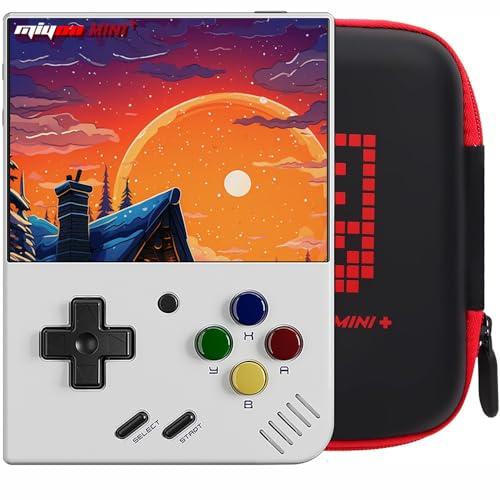
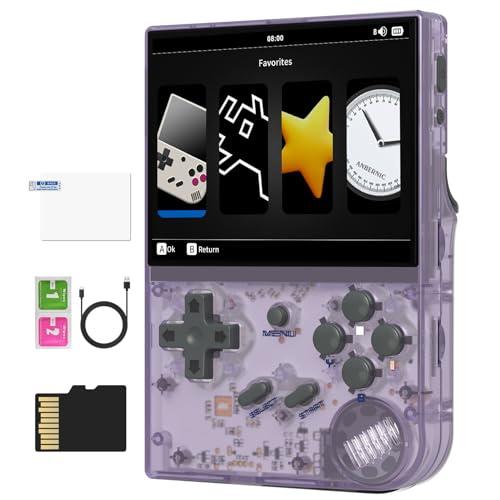
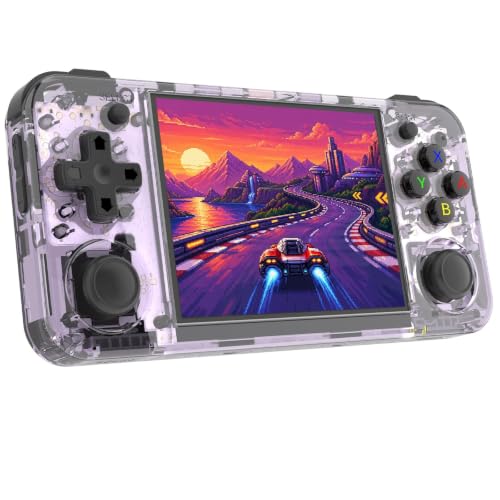
Buy the Anbernic RG35XX H. Between these two, it is the better device for more people: a horizontal body with two analog sticks, HDMI output to a television, and firmware that is good enough out of the box that you never have to touch it. The Miyoo Mini Plus is the one to buy if you want the smallest, prettiest handheld in the category and you are willing to flash community firmware to get the best from it — which is a real hobby, and for a lot of people the point. The budget pick of the three is the Anbernic RG35XX+ at around sixty dollars: the vertical Anbernic, for anyone who wants the Miyoo's shape at a lower price.
They cost roughly the same and they play the same games. The decision is not about value; it is about what kind of owner you are.
First: which RG35XX?
"RG35XX" is a family, not a device, and that is the first thing to settle. The RG35XX H is horizontal with two analog sticks and HDMI out. The RG35XX+ is vertical, in the Game Boy shape, with no sticks and TV output, and it is cheaper. The RG35XX H is the one we recommend, and it is the one this comparison treats as the Anbernic side — but if you are cross-shopping against the Miyoo specifically, you may actually want the vertical RG35XX+, because that is the same shape as the Miyoo at a lower price. Both Anbernics are in the table above.
The head-to-head
Shape
The Miyoo Mini Plus is vertical and tiny — a 3.5-inch screen in a body barely bigger than the screen, almost all face and almost no bezel. It is the best-looking device in the category and it genuinely fits in a pocket. The RG35XX H is horizontal with grips, which is less pocketable and much more comfortable after half an hour. This is the single biggest difference between them and it is a preference, not a ranking.
Analog sticks
The RG35XX H has two; the Miyoo Mini Plus has none. If your library includes PlayStation 1, Nintendo 64 or anything with a camera to control, this decides it outright. If your library is Game Boy, SNES, Mega Drive and arcade, it is irrelevant and the Miyoo loses nothing.
Screen
Both run 3.5-inch 640x480 IPS panels, and both are good. The Miyoo's looks larger relative to the device because there is so little around it. There is no meaningful quality gap to report here, and we are not going to invent one.
Firmware
This is the real divide. Anbernic's stock firmware is decent — you can buy an RG35XX H, switch it on, and be playing in a minute without ever thinking about software again. The Miyoo Mini Plus's reputation rests substantially on its community firmware, which is the strongest scene in the category and which transforms the device. If flashing custom firmware sounds like a fun Saturday, the Miyoo is the better device and it is not close. If it sounds like a chore you will never get round to, you will own a Miyoo running software you do not love.
Output and extras
The RG35XX H has HDMI output, which turns it into a small living-room console with a Bluetooth pad — see our budget controllers list, and note that an SNES-shaped pad is the right shape for these libraries. The Miyoo Mini Plus ships with a carry case, which at this price is a genuinely nice inclusion.
Price
They sit within a few dollars of each other, with the vertical RG35XX+ some way below both. Live prices are in the table above with the date they were read. At these numbers the price is not the deciding factor and should not be treated as one.
The verdict
Buy the Anbernic RG35XX H if you want a handheld that works properly the moment you open the box, you want analog sticks, or you want to plug it into a television. This is most people, and it is why it tops our best retro handheld list.
Buy the Miyoo Mini Plus if you want the smallest, nicest-looking device here, your library is 2D, and the custom-firmware scene is an attraction rather than a warning.
Buy the Anbernic RG35XX+ if you want the Miyoo's vertical shape for less money and Anbernic's out-of-the-box software.
Neither of the first two is a mistake, and the people who are unhappy with either are almost always the people who bought the other one's strengths by accident.
How we ranked these
We did not take these devices apart, run benchmarks on them or award them anything. What we did is the thing the big review sites skip: resolve every model to a live Amazon listing, confirm it is actually in stock, read the specification the seller publishes, and then sort the shelf by what the device physically is and what it costs today. Prices come from the Amazon Product API and carry the date they were read; where we have no verified live price the button says "Check price" rather than showing a number that has rotted. See how we pick and our editorial policy.